You brought home a tomato seedling full of promise, set it on your sunniest windowsill, and watered it faithfully. For a while, everything looked great. Then one day you noticed it just stopped growing. No new leaves. No flowers. Just sitting there, stubbornly frozen in time.
If this sounds familiar, you’re not alone. Indoor tomato plants hit the brakes for reasons that outdoor gardeners rarely worry about. The good news? Most of these problems come down to a handful of mismatches between what tomatoes naturally expect and what our homes actually provide.
Tomatoes evolved to grow in full sun, with plenty of root space and warm days followed by cool nights. Your apartment offers something quite different. Lower light levels, consistent temperatures, limited soil volume, and still air create conditions that can confuse or stress the plant.
Here’s something else worth knowing. A tomato that stops growing doesn’t always look the same way. A young seedling might stretch tall and weak, getting leggy instead of bushy. A bigger plant might keep making leaves but never form flower buds. Or you might see flowers that drop off without setting fruit. Each of these situations signals a different kind of stall, and each one points to a specific fix.
The encouraging part is that once you understand what your plant is missing, you can usually give it what it needs. Let’s look at the most common reasons indoor tomatoes stop thriving and what actually works to get them growing again.
The light looks bright to you but is dim to a tomato
Your eyes are incredibly good at adjusting to different light levels. A room that feels bright and comfortable to you might actually be quite dim for a plant that evolved in full sun. Tomatoes are sun worshippers. In their natural habitat, they’re bathed in direct sunlight for hours every day, and that’s what their growth system expects.
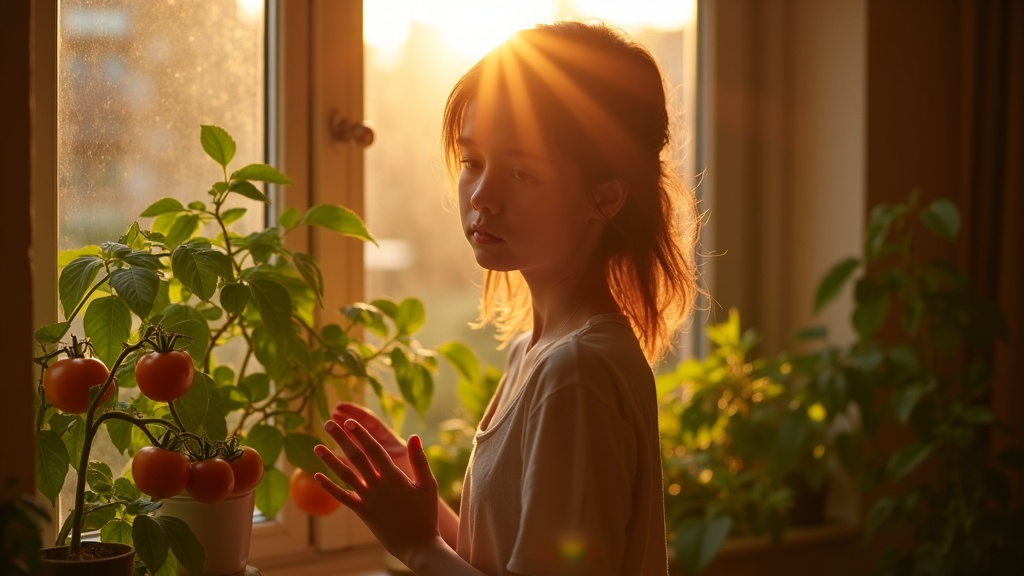
A sunny window seems like it should be enough, but it often isn’t. Even a south-facing window only delivers a fraction of outdoor light intensity, especially if the plant sits a few feet back from the glass. North-facing windows are even dimmer. And in winter, the sun stays low and weak, so even your best window might not cut it for steady tomato growth.
When your tomato doesn’t get enough light, it shows you. The stems get long and spindly, stretching desperately toward the window. The plant might lean hard in one direction, practically begging for more sun. New leaves come in pale or yellowish instead of deep green. You’ll notice long, awkward gaps between leaf clusters instead of compact, bushy growth.
The plant might not stop growing entirely, but everything slows way down. New growth creeps along at a frustrating pace. Flowers might not form at all, or they appear but drop off before fruiting.
Day length matters too. Tomatoes need a solid stretch of bright light each day to fuel their growth. Six hours in a window isn’t the same as six hours outdoors because the angle keeps changing and walls block light from the sides. Your apartment might feel sunny, but your tomato is quietly starving for the real thing.
Apartment temperatures and drafts can quietly shut growth down
Tomatoes are warm-weather plants at heart. When they get consistently cool, they don’t die dramatically. They just slow down or stop growing altogether. You’ll water them, check the soil, make sure they’re getting light, and nothing seems wrong. But the plant sits there, frozen in time, not getting any bigger.
The tricky part about apartments is that temperatures aren’t uniform. A windowsill might feel fine to you during the day, but at night that glass gets cold. Really cold. Your tomato plant is pressed right up against it, and suddenly it’s spending twelve hours in conditions that make it want to hibernate. The leaves might even take on a purple tinge, especially on the undersides. That’s the plant’s way of saying it’s too cold.
Then there are the drafts. An air conditioning vent blowing directly on your plant creates a pocket of cold air that hits the same leaves over and over. A plant near a door that opens frequently gets temperature shocks multiple times a day. Even a spot above a radiator can cause problems, not because it’s too hot, but because the temperature swings wildly between heating cycles.
The symptoms are frustrating because they look like nothing. New leaves stall out when they’re tiny. Flowers form but drop off before they set fruit. The plant looks green and healthy, just stuck. It’s not diseased. It’s not starving. It’s just cold enough, often enough, that growth has quietly shut down. And because you can’t see temperature the way you see wilting or brown spots, it’s easy to miss what’s actually happening.
Overwatering indoors often means the roots can’t breathe
Here’s the tricky thing about growing tomatoes inside: soil dries out much slower than it does outdoors. There’s no wind, no direct sun beating down on the pot, and often not much air movement at all. That means the potting mix stays wet longer, sometimes for days after you water.
When soil stays soggy, the tiny air pockets between soil particles fill up with water. Roots need oxygen just as much as they need water, and when those spaces stay flooded, the roots essentially suffocate. They can’t do their job of pulling up nutrients and water to feed new leaves and stems, so growth just stops.
The confusing part is that an overwatered tomato plant often looks a lot like an underwatered one. Leaves might droop or turn dull. They can yellow from the bottom up while the whole plant seems stuck in place. You might think it needs more water or fertilizer, but the real problem is happening below the surface.
A few simple signs can help you spot overwatering before it stalls your plant completely. Pick up the pot. Does it feel heavy days after watering? Press your finger into the soil an inch down. Is it still wet or cold to the touch? Those are red flags.
You might also notice tiny flying insects called fungus gnats hovering around the soil. They love consistently moist conditions. In more serious cases, the potting mix can start to smell sour or musty instead of earthy. And if you’re using a decorative pot without drainage or a saucer that holds water underneath, you’re creating the perfect recipe for drowning roots and stopping growth.
The container can cap the plant’s size sooner than you expect
Your tomato plant might look healthy on top, but underneath the soil, it could be running out of space much faster than you realize. Tomatoes grow aggressive root systems that want to spread out and dig deep. When they can’t, the whole plant pays the price.
Here’s what happens: roots keep growing until they hit the container walls, then they start circling around and around, looking for somewhere to go. This is called becoming root-bound. Once the roots fill up all the available space, they can’t absorb water and nutrients efficiently anymore. The plant essentially hits a ceiling.
You’ll notice the symptoms pretty quickly. The soil dries out absurdly fast, sometimes within hours on a warm day. You water in the morning, the plant perks up briefly, then by afternoon it looks droopy again. New growth slows to a crawl or stops completely. Flowers might form, then drop off before they ever become fruit.
Indoor growers often start tomatoes in small pots with every intention of moving them later, then forget or delay the upgrade. Or they choose shallow decorative containers that look nice on a windowsill but don’t give roots anywhere to go. Sometimes people try to cram multiple plants into one pot to save space, which just speeds up the problem.
If you tip the plant out and see a dense tangle of roots circling the outside of the soil, or roots poking through drainage holes, that’s your answer. The container became the limit, not the light or your watering schedule. Your plant isn’t failing to thrive because you’re doing something wrong. It simply ran out of room to grow.
Fertilizer can be too little, too much, or stuck in the soil
Indoor tomato plants face a feeding puzzle that outdoor plants don’t. In a garden bed, nutrients come from organic matter breaking down over time, and rain naturally flushes away excess salts. Your pot has neither of these advantages. What you put in stays in, and what runs out is gone forever.
The most common mistake is feeding too little or stopping too soon. Seedlings start with enough nutrients in their soil mix to get going, but once they’re a few inches tall and pushing out real leaves, they’re hungry. If you never fertilize, growth slows to a crawl. The leaves turn pale yellow-green, starting from the bottom. New growth gets smaller and smaller. The plant isn’t dying, but it’s stuck.
The opposite problem is just as common. Tomatoes need food, so it’s tempting to feed heavily or often. Too much fertilizer burns the roots. You’ll see leaf edges turn brown and crispy, almost like they’ve been singed. New growth at the tips may stop entirely, even though the rest of the plant looks green. The plant goes into defense mode instead of growing.
Then there’s the invisible problem: salt buildup. Every time you fertilize, trace minerals and salts accumulate in the soil. Over weeks and months, a white or tan crust forms on the soil surface or around the drainage holes. This crusty layer blocks the roots from absorbing anything, even if you’re feeding correctly. The plant acts starved no matter what you do.
Outdoor plants get rinsed by rain. Indoor plants don’t. If your tomato stopped responding to care and the soil looks crusty, that’s usually the reason.
Still air and indoor humidity swings can stress tomatoes more than you’d think
Outdoor tomatoes get something for free that indoor plants almost never do: a steady breeze. Even gentle air movement helps leaves dry faster, strengthens stems, and keeps the plant breathing properly. Indoors, that air often just sits there.
Most apartment tomato setups put plants exactly where air doesn’t move. They end up tucked in corners, grouped tightly with other houseplants, or pushed behind a curtain near a window. The leaves stay damp for hours after you water. The soil surface takes forever to dry. This creates a quiet problem that slowly drains your plant’s energy.
When air barely moves, your tomato can’t transpire well. That’s just the plant’s way of pulling water and nutrients up from the roots through the leaves. Stagnant air slows this whole process down, which means slower growth overall. The stems stay thin and weak because the plant isn’t getting the tiny workout that moving air provides.
Worse, that constant dampness invites trouble. You might notice fungus gnats hovering around the soil or small spots appearing on lower leaves. These aren’t always full-blown diseases, but they’re signs that your plant is spending energy dealing with stress instead of growing.
The fix doesn’t require anything fancy. Just a bit of air circulation makes a huge difference. Cracking a window when weather allows, running a regular household fan on low nearby, or even moving the plant away from that crowded corner can help. The goal isn’t to blast your tomato with wind. You just want enough movement that leaves dry within an hour or two and the plant can breathe easy.
Indoors, flowers may not turn into fruit without a little help
You might notice your indoor tomato plant blooming just fine, but then the flowers drop off without producing anything. Or maybe you see a tiny green nub forming where the flower was, only to watch it turn yellow and fall away a few days later. This is one of the most frustrating indoor tomato plant problems, and it makes your plant feel stuck in place even though it’s technically healthy.
The issue is pollination. Tomato flowers are self-pollinating, meaning they don’t need another plant nearby. Each flower has everything it needs to make fruit. But here’s the catch: the pollen still needs to move from one part of the flower to another, and outdoors that happens naturally. Wind shakes the plant. Bees buzz around and vibrate the flowers. These small movements release the pollen so it can do its job.
Inside your apartment, there’s no wind. There are no bees. The air sits still, and the pollen just stays put. Sometimes indoor conditions make things worse. If your apartment is very humid or the temperature swings a lot, the pollen can get sticky or clumpy and won’t release easily even if you try to help.
Many indoor growers fix this by gently shaking the plant or tapping the stems when flowers are fully open. You’re mimicking what wind and insects would do outside. The timing matters because flowers are only receptive for a short window, usually a few days when they’re bright yellow and fully opened. A light daily tap during blooming season is often enough to turn those flowers into actual tomatoes instead of disappointments that drop to the floor.
Some tomato types just aren’t happy living on a windowsill
Not all tomato plants are built for life indoors. Some varieties are naturally compact and bushy, perfectly content in a pot on your counter. Others want to become sprawling vines that climb six feet tall and spread in every direction. When you try to grow that second type in an apartment, things can get awkward fast.
These vigorous plants are called indeterminate tomatoes, which just means they keep growing taller and bushier as long as conditions allow. They’re the marathon runners of the tomato world. The compact ones are called determinate, and they grow to a certain size and stop. Think of them as the calm, well-behaved cousins.
When an indeterminate plant lives indoors, it often hits an invisible wall. It doesn’t have enough light to fuel all that growth. The pot is too small for the root system it wants to build. There’s nowhere to climb. So the plant just stalls out. It looks stuck, maybe a bit leggy or pale, like it’s waiting for permission to keep going.
This isn’t always a sign something’s wrong with your care. It’s often just a mismatch between what the plant wants to do and what your windowsill can offer.
It’s also worth knowing that tomatoes indoors generally grow slower than the timelines you see on seed packets. Those estimates assume outdoor summer light. If you’re growing in winter or relying on a window, everything takes longer. Early growth can feel painfully slow, and that’s often completely normal. Your plant isn’t broken. It’s just working with what it’s got.