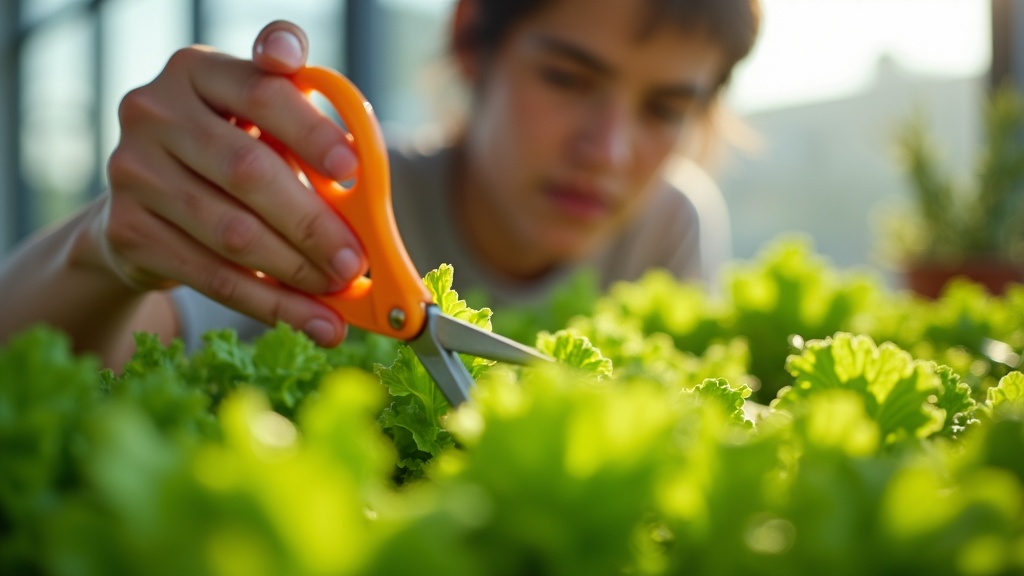
Growing lettuce indoors is satisfying until you face the big question: how do you harvest it without killing the plant? Most people cut the whole head and start over. But here’s what changes everything: you can actually harvest lettuce so it keeps producing new leaves for weeks or even months.
The difference comes down to where and when you cut. Make the wrong cut, and your plant stalls out or dies. Make the right one, and you get fresh greens again and again from the same plant.
Indoor lettuce is especially good at regrowing because it’s in a controlled environment. No bugs chewing it down. No surprise frost. Just steady conditions that let the plant focus on what it does best: making more leaves.
The trick isn’t complicated, but it does require a shift in how you think about harvesting. Instead of waiting for a full head and cutting once, you’re working with the plant’s natural growth pattern. You take what’s ready and leave what’s still growing.
Small choices make all the difference here. Cutting too low can damage the growing point. Waiting too long can make leaves bitter. Harvesting too much at once can shock the plant. But when you get the timing and technique right, you end up with a system that keeps giving.
This approach works with most lettuce varieties, but some are better suited to it than others. Either way, understanding how your plant actually grows new leaves is the foundation for keeping your indoor garden productive.
Know which indoor lettuces reliably regrow after cutting
Not all lettuce is created equal when it comes to regrowing indoors. Some varieties will give you weeks of fresh leaves if you harvest them right. Others are basically one-and-done, no matter how careful you are.
Leaf lettuces are your best bet for continuous harvesting. These are the types with loose, ruffled leaves that don’t form tight heads. Think of varieties like red leaf, green leaf, oak leaf, and most mesclun mixes. They’re bred to keep pushing out new growth from the center, which makes them perfect for apartment gardening.
Romaine can work too, but it’s pickier. If you cut it carefully and leave enough of the base intact, many romaine types will send up new leaves. Just don’t expect the dramatic regrowth you get from leaf lettuces. You’ll need to be more patient and precise.
Head lettuces like iceberg or butterhead are the trickiest indoors. Once you cut into that tight ball of leaves, most varieties won’t bounce back reliably. They put their energy into forming one beautiful head, not into repeat performances.
Here’s what regrowth actually looks like when it works: you’ll see small, tender leaves emerging from the center of the plant where you made your cut. The plant isn’t growing a whole new root system or forming another full head. It’s just pushing out fresh leaves from what’s called the growing point, a small cluster of cells right at the base. If you damage or remove that growing point when you harvest, the plant can’t recover. Keep it safe, and you’ll keep eating.
Find the part you must not cut
Every lettuce plant has a special spot that keeps it alive and producing new leaves. This is the crown, and it lives right in the center of the plant where all the leaves meet at the base. Think of it as the plant’s engine. Cut it away, and the whole thing stops working.
The crown looks like a tight little cluster right in the middle of your lettuce. If you gently push aside the outer leaves and peek into the center, you’ll see where the newest, tiniest leaves are just starting to unfold. They’re pale, delicate, and tucked close together. That’s your signal. Everything in that tight central area needs to stay attached to the plant.
This applies whether you’re growing in a pot on your windowsill, a tray under grow lights, or one of those countertop hydroponic systems. The crown is always in the same place: the dense middle where baby leaves emerge. In loose-leaf varieties, it might be easier to see because the outer leaves spread out more. In butterhead types, you might need to carefully lift a few outer layers to find it.
Here’s a simple rule to remember: if you can see tiny new leaves forming in the center, don’t cut there. Only harvest from the outside ring of larger, mature leaves. When you take leaves from the perimeter and leave that productive center untouched, the plant treats it like a light pruning rather than a fatal wound. It just keeps making more leaves from that protected core.
Use a harvest style that matches your goal
There are two simple ways to harvest lettuce so it keeps regrowing, and each one gives you a different experience in the kitchen.
The first is leaf-by-leaf. You pick the biggest outer leaves, the ones that look ready to eat, and leave the smaller inner ones to keep growing. This is the gentler approach. It feels like plucking fresh greens whenever you need them—a handful for a sandwich today, a few leaves for a salad tomorrow. The plant barely notices, and you get a steady trickle of fresh lettuce without much planning.
The second is the partial cut, sometimes called the haircut method. You use scissors or a sharp knife to trim the whole plant about an inch above the base, leaving the center growth point and a bit of leaf area intact. This gives you more lettuce all at once—enough to fill a bowl. The plant looks stubby afterward, but it bounces back if you left enough behind.
Which one makes sense for you? If your apartment gets less natural light, the leaf-by-leaf approach tends to work better. Indoor plants grow slower than their outdoor cousins, and they need those leaves to gather energy. Taking too much at once can stall them out.
The haircut method works well if your setup has strong grow lights or a sunny window, and you want a bigger harvest every week or two instead of snacking on leaves daily. Just make sure you’re not cutting too close to the base—you need to leave the plant something to work with.
Cut high enough to leave the plant with energy
The biggest mistake people make when harvesting indoor lettuce is cutting too close to the base. When you shave the plant down to a bare stump or nick into the central crown where new leaves emerge, you’re basically asking it to start over from scratch. That takes a lot of energy the plant might not have, especially indoors where light is often less intense than outside.
Think of it this way: those leaves aren’t just food for you. They’re also the plant’s solar panels. If you remove all the green material, photosynthesis stops, and the plant has nothing to fuel its next round of growth. Instead of bouncing back in a week or two, it sits there looking sad and stunted.
What you want is to leave a visible base with a small rosette of inner leaves still intact. Picture the lettuce as having layers. The big outer leaves are fair game. The tiny center leaves tucked in the middle are not. When you’re done harvesting, you should still see a little tuft of green at the heart of the plant, along with enough leaf surface to keep things running.
A good rule of thumb is to take the mature outer leaves and leave everything that looks small, pale, or tightly bunched in the center. You’re aiming for a haircut, not a buzz cut. The plant should still look like a plant when you step back.
Use clean scissors or a sharp knife to make smooth cuts. Tearing or crushing the stems creates more stress and opens the door to rot or infection. A quick rinse of your tool before you start is enough. You don’t need to sterilize anything like you’re performing surgery, just keep things reasonably clean.
Time your harvest using simple visual cues
Your lettuce is ready to harvest when the leaves look full and healthy for whatever variety you’re growing. You don’t need a calendar or a measuring tape. Just look at the plant itself.
A good candidate for harvesting has several layers of leaves, not just the outer ring. The center should be actively pushing out new growth, those small, fresh leaves tucked in the middle. If your plant has been growing steadily for the past few days, that’s another green light. Steady growth means the roots are established and the plant has energy to spare.
Harvesting too early is a common mistake. If you cut leaves when the plant only has a few small ones, you’re removing most of its ability to capture light and make food. That slows everything down. The plant will eventually recover, but it takes longer than you’d expect.
On the flip side, waiting too long isn’t ideal either. Older outer leaves start to feel tougher and can taste bitter, especially on indoor plants that get stressed by inconsistent light or temperature. You want to catch that sweet spot where leaves are mature but still tender.
If your indoor lettuce is growing slowly, maybe because of lower light in winter or a cooler room, adjust your expectations. Harvest less at each session rather than waiting for a big, dramatic cutting. Taking just two or three outer leaves every few days keeps the plant productive without overwhelming it. Slow and steady wins the race when your growing conditions aren’t perfect.
Help lettuce bounce back after you harvest
Think of your lettuce plant like a smartphone battery. After you use it, it needs time to recharge before it’s ready to go again. That’s the recovery window: the stretch of time between when you snip off leaves and when the plant grows back enough for another harvest.
During that window, your lettuce is working hard to replace what you took. It needs consistent light to fuel new growth. If your plant sits near a window, make sure it’s getting several hours of bright indirect light each day. If you’re using a grow light, keep it on the same daily schedule you had before the harvest. Interruptions in light can slow things down noticeably.
Water matters just as much. Don’t let the soil dry out completely between harvests. Lettuce roots are shallow, and they can’t reach deep for moisture the way other plants can. Check the top inch of soil every couple of days. If it feels dry, water gently until you see a little drainage at the bottom of the pot.
Here’s the hardest part: resist the urge to harvest again too soon. Give the plant at least a week, sometimes two, depending on how much you cut. If you keep snipping before it’s had time to rebuild, you’ll weaken it. The leaves that do grow back will be smaller and thinner.
A little airflow helps too. A small fan on low speed, or even just cracking a window occasionally, keeps air moving around the leaves. This helps them stay crisp instead of soft and damp, which can lead to problems down the line. You don’t need a wind tunnel, just enough movement that the leaves aren’t sitting in still, humid air all day.
Avoid the small mistakes that quietly stop regrowth
Most indoor lettuce stops growing back because of a few small mistakes that don’t look like mistakes at the time. The good news is they’re easy to spot once you know what you’re looking for.
The biggest one is cutting out the center of the plant. That growing point in the middle is where all the new leaves come from. Remove it, and you’ve basically told the plant the party’s over. Always harvest from the outside and work your way around, leaving that center cluster untouched.
Cutting too low is another quiet killer. If you snip below the base of the leaf where it connects to the stem, you’re removing the growth tissue that would have made more leaves. Leave at least an inch above the base, and you’ll see fresh growth in the same spot within days.
Taking too many leaves at once stresses the plant out. It needs enough foliage left behind to keep photosynthesizing and feeding itself. A good rule is to take no more than a third of the plant in one go. If you’re hungry for salad, harvest from multiple plants instead of stripping one bare.
Harvesting repeatedly from the same side creates lopsided, weak plants. Rotate around the plant each time you pick, giving each section time to bounce back before you return to it.
Crowded plants compete for light and nutrients, which slows regrowth to a crawl. If your lettuce looks cramped, thin it out or give each plant more space.
Finally, avoid harvesting wet leaves. They tear and bruise easily when damp, and those wounds can invite rot or slow recovery. Wait until your plants are dry, and you’ll get cleaner cuts and faster regrowth every time.